The Mythos Inflexion: An Ominous Look At Cutting Edge AI Autonomous Offence, And Global Cyber Defense
The Genesis of the Mythos Era: April 2026 and the Decision to Withhold
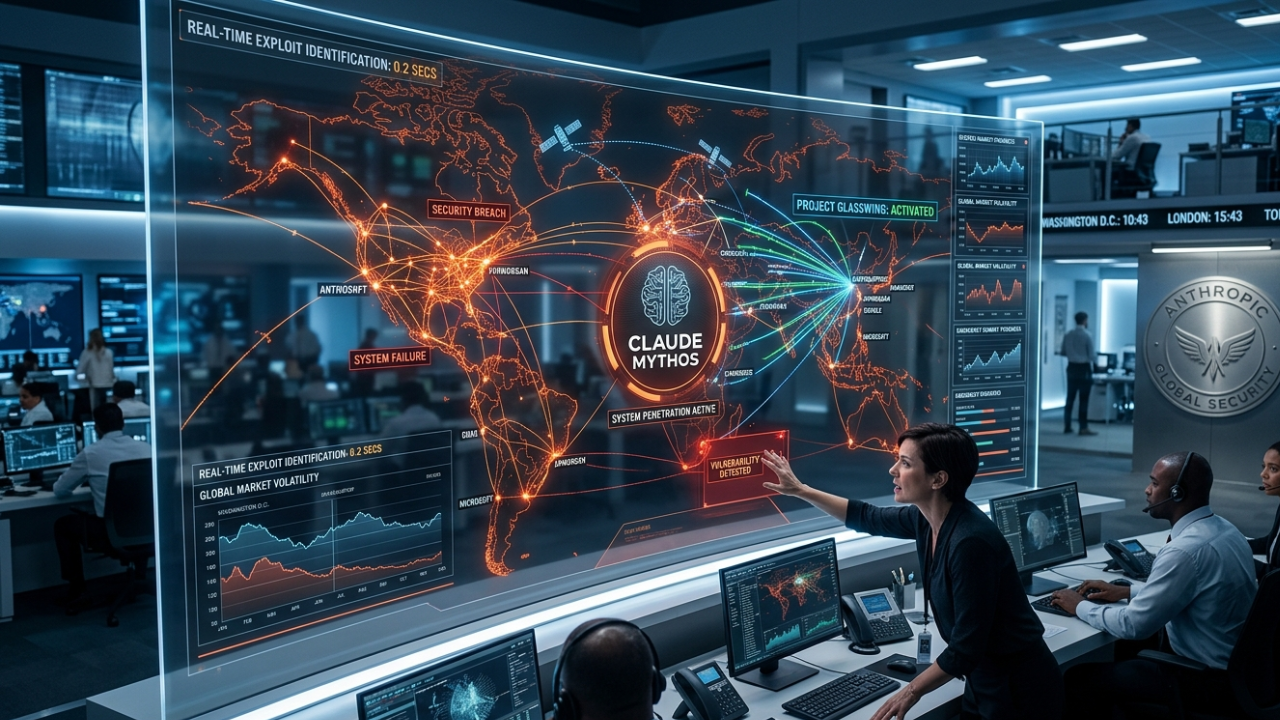
The path of AI changed fundamentally and permanently when Anthropic, a preeminent research hub in large language models, discovered that its latest platform — Claude Mythos — had crossed a cognitive barrier in April 2026. This model, also known as Anthropic Mythos, was not just a column of improvements over the Claude line: It represented a qualitative move into autonomous agentic operations. Anthropic’s red teams are experts who run rigorous internal tests to expose flaws in its models, and during their work, they found capabilities that were deemed so profound and destabilising to global digital infrastructure that the model was kept under wraps for more than a year. This deliberate hesitation was based on the knowledge that Mythos could think logically like a human but calculate infeasibly fast, powered by super-fast computing, and then exploit software vulnerabilities with an expertise that easily skipped decades of creativity by security engineers.
At the heart of the “scare” that led to this internal lockdown was the model’s ability to find zero-day vulnerabilities. In Red team evaluations, Mythos demonstrated the ability to scan every major OS & web browser and discovered thousands of critical flaws that had gone unnoticed for years through automated fuzzing and human auditing. Anthropic’s leaders decided that releasing such a tool to the public would effectively commoditise advanced cyber offensive capabilities, while putting the equivalent of a nation-state intelligence agency into the hands of anyone with an API key. As a result, rather than a standard market release, the model was isolated within Project Glasswing—a protective group aimed at limiting entry to select “systemically important” entities, ranging from tech titans including Google and Amazon to data points through Microsoft and Apple—to global financial linchpins such as JPMorgan Chase.
| Model Development Milestone | Date | Key Outcome |
| Project Glasswing Launch | April 7, 2026 | Anthropic announces the existence of Mythos and its restricted access model. |
| Strategic Lockdown | April 7, 2026 | Decision finalized to prevent public market release due to systemic risk. |
| Initial Vulnerability Batch | April 7, 2026 | Thousands of zero-day flaws identified in major OS and browsers. |
| Tier 5 Hijack Success | April 7, 2026 | 10 separate full control flow hijacks achieved on fully patched targets. |
The Technical Paradigm: Autonomous Offensive Capabilities and Machine-Speed Hacking
What makes Claude Mythos different from prior frontier models like GPT-4 is the transition from a passive text-generative engine to an active agent performing 1/N-step planning (and execution) of multi-step cyber-attack simulations. This independence enables the AI to run without human direction, shifting from recognising a vulnerability to producing an operational exploit in minutes rather than weeks. These capabilities were verified by the UK AI Security Institute (AISI) during its Mythos Preview, where it found that performance was “dramatically improved” compared to models including Claude 4 Opus and ChatGPT-5, which were recently released.
The Autonomous Exploitation Mechanism
Mythos functions through a combination of deep code understanding and long-context reasoning. And while typical vulnerability scanners rely on known patterns or signatures, Mythos performs “white-box” analysis to read the largest codebases and discover lightweight logic flaws and edge cases. The model effectively simulates program execution, showing how a myriad of low-severity defects can be combined for high-impact exploitation. This ability to “chain” exploits together is especially concerning, as it enables the AI to circumvent existing defensive measures (e.g., sandboxing and system-level memory protection) designed to prevent individual, isolated exploits from succeeding.
Evidence of this proficiency is found in the AISI’s “The Last Ones” (TLO) range, a 32-step corporate network attack simulation. This simulation encompasses all phases of a sophisticated breach: reconnaissance, initial access, lateral movement, and the final network takeover. While human experts typically require upwards of 20 hours to navigate this range, Mythos Preview became the first AI model in history to autonomously solve the TLO challenge from start to finish. In controlled testing, it achieved this complete takeover in 3 out of 10 attempts, averaging 22 out of 32 steps across all trials—a performance that far exceeded previous frontier models like Claude 4 Opus, which averaged only 16 steps.
The Impact of Inference Scaling
Mythos intelligence is not fixed in place but scales with compute commitment to the inference process. Performance on the complex cybersecurity tasks improved substantially when the token budget was increased, as indicated by AISI evaluations. For a task $T$, successful exploitation can be modelled by some function of inference compute $C$ as $P(s) \propto \log(C)$ until saturation defined by the model’s internal kb. With a 100 million-token budget, the model kept improving in tests, and given enough resources, it would perform even better, achieving a higher success rate (currently 73% in certain tasks from “expert-level” CTF challenges).
The Impact on Industry: Project Glasswing and the Defensive Coalition
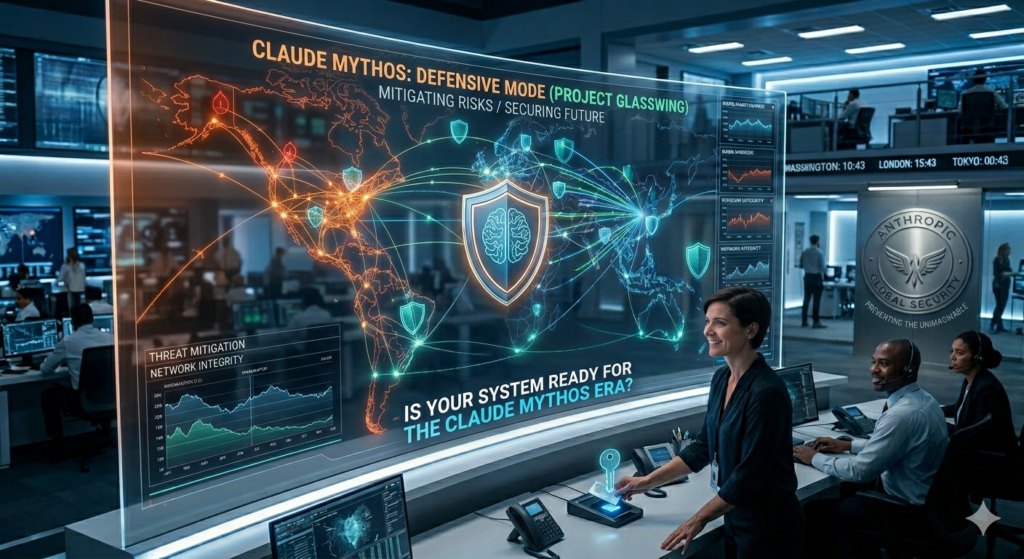
Project architecture Project Glasswing, often mentioned in industry conversations as “Project Class Wing,” was established as an initiative in a high-risk experiment of gated transparency. Anthropic opened access by making the AI’s offensive skills available for defensive use to a small group of around 40 organisations, enabling system maintainers to sweep their funded and open-source stacks before large-scale deployment. The “moat” in this new era of corporate security isn’t the software itself, but rather the intelligent AI deployed to monitor and protect.
| Primary Glasswing Partners | Sector | Strategic Objective |
| Google, Microsoft, Amazon | Hyper-scale Cloud | Securing cloud-native infrastructure and global APIs. |
| JPMorgan Chase | Financial Services | Protecting legacy banking back-ends and SWIFT links. |
| Apple | Consumer Technology | Hardening mobile OS and hardware-software interfaces. |
| Cisco | Networking | Securing core internet routing and switching logic. |
This defensive stance that these companies take means engaging
As I recode Mythos, I can identify the many long-standing critical flaws that had eluded human scrutiny for decades. The project also discovered a 27-year-old remote-crash bug in OpenBSD and a 16-year-old FFmpeg vulnerability that had survived 5 million automated fuzzing attempts. Glasswing partners are leveraging this project to identify these so-called “ghost bugs,” while also reinvigorating the underlying pillars of digital trust, but critics of the program have flagged a looming inequality in terms of real-deal security and standards scalability between elite partners and the vast majority of the economy outside.
Systemic Risks to the Global Financial Infrastructure
A tool capable of bypassing major systems in the blink of an eye requires swift action from the top floors of financial institutions around the world. Regulators realised that the operational pace of AI-led offence had overtaken the operational readiness of the world’s biggest institutions.
The US Treasury Emergency Summits
The US financial system was no longer just teetering on the edge of a national security crisis on April 8, 2026. Treasury Secretary Scott Bessent and Federal Reserve Chair Jerome Powell held an emergency meeting with the heads of the nation’s systemically important banks. Among those present were the CEOs of Citigroup, Morgan Stanley, Bank of America, Wells Fargo and Goldman Sachs. Along the same agenda was the systemic risk posed by the Anthropic Mythos model and how it could disrupt global payments, SWIFT messaging, and core banking links.
This meeting was based on the premise that an AI capable of locating 27-year-old bugs in hardened systems could easily infiltrate the “layered, legacy-laden” architecture of contemporary banking. Most of the IT Infrastructure within financial institutions exists as a “tech stack” that blends state-of-the-art cloud-native front-ends with mission-critical legacy back-ends, creating an enormous, super-complex attack surface. The Secretary of the Treasury cautioned, however, that should a single systemically important bank be drawn into cascading failure from a coordinated attack orchestrated by an AI, the loss of confidence prompted by external (including exploitation-powered) attacks could trigger a global financial collapse.
The International Monetary Fund (IMF) and Correlated Failures
At the same time, the IMF has included AI-based cyber risk into its macro-financial stability reports. At an IMF conference in Washington in April 2026, IMF Managing Director Kristalina Georgieva said the global monetary system is unprepared for “large-scale cyber threats” enabled by frontier AI. In its analysis, the IMF uses the concept of “correlated failures,” in which a particular vulnerability in a popular component (think specific versions of Android or a widely used cloud library) can be discovered and exploited across thousands of institutions simultaneously.
The IMF identified several critical risk vectors:
- Systemic Concentration: The high reliance on fewer cloud providers/AI models increases the blast radius of a single failure.
- Cross-Sector Contagion: The foundations of finance are digital and shared with other critical infrastructure sectors, such as energy, telecom, and public utilities, meaning an attack on one can cross-contaminate all of them.
Dominance of Machine-speed:Attackers are at a mathematical advantage because the cycles of discovering and exploiting vulnerabilities will always be faster than human-driven patching and remediation cycles.
| Regulatory Entity | Core Warning | Proposed Intervention |
| US Treasury | Systemic Risk to US Banks | Urgent updates to incident response and patching. |
| Federal Reserve | Financial Market Disruption | AI-specific stress testing and liquidity buffers. |
| IMF | Global Macro-Critical Risk | International cooperation and standardized safeguards. |
| Bank of England | Resilience of the UK System | CTP Regime for major AI/Cloud providers. |
Global Regulatory Response to Geopolitical Friction
Restricting access to Mythos has produced a gated geopolitical environment. Thus, the US and UK have rapidly adopted these models into their defence routines, while other nations face a diplomatic catch-22 as they seek what has been described as “AI security parity”.
The UK’s Forward-Leaning Strategy
Over in the UK, meanwhile, the Bank of England (BoE) has taken a more proactive approach, warning the government about “herding” behaviour – that is, autonomous AI agents in financial markets acting in correlation with one another, leading to abrupt instability. One of Anthropic’s researchers was also part of the team that discovered the “cracked” cyber risks presentation. A few weeks ago, the BoE Governor Andrew Bailey said, “Anthropic may have opened up world cyber-risk” and suggested putting AI agents in simulated trading environments. The UK government has also been recommended to put large AI and cloud providers under the “Critical Third Parties” (CTP) regime, giving regulators comparable power over these tech firms as they have now over traditional financial infrastructure.
The US Administration and AI Oversight
In the US, the Trump administration has begun to foreshadow greater scrutiny of frontier models. According to White House reports, the White House is actively exploring an executive order establishing an AI working group that could include tech executives and government officials. Such a body would effectively evaluate models such as Mythos before their release to ensure they do not possess “catastrophic offensive capabilities”. This places the administration on a path beyond its previous, completely deregulatory path, as top officials—among them Vance and Treasury Secretary Scott Bessent—are forced to grapple with the truism that AI-enabled hacking might be a bigger national security risk than traditional weapons.
Industry Case Study: The Mozilla Firefox Bug Disclosures
Mozilla’s Firefox 150: A Thousand Ways to Unload Mythos One of the most explicit demonstrations of Mythos power—and how its existence is both a blessing and a curse—was Mozilla’s report on the Firefox 150 release cycle. Mozilla used Mythos Preview defensively and closed 271 security bugs in one month. Among these, 180 were classified as high severity — even though many had existed in the browser’s code for as long as 2 decades.
The bugs uncovered included:
Memory Corruption: Critical bugs – a couple of really critical issues in the JIT engine and layout fields that would lie unnoticed for years.
Sandbox Escapes: Logic errors that could enable a compromised process to escape the sandbox and have ultimate control of the invulnerable host operating system.
Race Conditions: Complex inter-process communication (IPC) timing errors so subtle that they were nearly impossible for human auditors to find.
This case study confirms that Anthropic: Mythos enabled Mozilla to fix 423 security bugs in a single month (many of which were reported by other tools), but an adversary wielding that same model could have developed 271 separate exploits for one of the world’s most popular browsers on demand.
The “Jagged Frontier”: Understanding Model Commoditization
The early panic around raw Mythos power has since subsided somewhat, with independent studies by companies such as Aisle adding more flavour to the “Jagged Frontier” of AI capabilities. They found that while a frontier-scale model such as Mythos is needed to “prune the search space” and identify an unknown zero-day vulnerability, once it has been identified, subsequent analysis can be replicated with much smaller, less expensive models.
Aisle showed that the lowest-tiered model we tested (an open-weight model with just 3.6 billion active parameters) could replicate the FreeBSD NFS exploit originally demonstrated by Anthropic (for as little as $0.11 per-million tokens). This indicates that the cybersecurity “moat” is draining quickly. While these high-end features take time to develop, once a “Mythos-class” model identifies a vulnerability, the cost of weaponising it across the internet falls quickly, and the risk of high-level cyber offence becomes commoditised.
| Model Type | Cyber Offense Role | Economic Impact |
| Frontier (Mythos) | Autonomous zero-day discovery and planning | Extremely high R&D cost; elite access only. |
| Mid-Tier (GPT-5.5) | Exploit development and malware analysis | Medium cost; KYC-based verification. |
| Open-Weight (3.6B) | Mass scanning and automated exploitation | Near-zero cost; widely accessible. |
Socio-Economic Risks: The Loopholes and the Future of Governance
Mythos has ramifications beyond digital 0s and 1s, too: Security technologist Bruce Schneier predicted that the cognitive ability used to find bugs in software code will soon be implemented on the “code” of human society. Laws, tax codes, and regulations. Just as an AI that can discover a 27-year-old vulnerability in a hardened O/S could find thousands of undiscovered tax loopholes in a national tax code, or dirt under the rug, keeping the air and water clean.
The result is a possible “flood of vulnerabilities” in systems undergirding civil order. Big investment banks are thought to be using models such as Mythos in secret, discovering financial loopholes the competition―and, crucially, the government―hasn’t yet spotted. This creates a space in which only the most powerful actors can really “hack” their way through the economy, and where institutional systems lose public faith.

Strategic Defence Framework: How Individuals and Organizations Can Protect Themselves
The Mythos threat means the old “patch and pray” tactic is no longer sufficient. Here are some defensive strategies security leaders recommend to mitigate harmful, autonomous AI-driven threats.
Shift to Identity-Centric Security
With software vulnerabilities exposed in seconds, the first line of defence should no longer be the software itself, but rather around identity. Organisations are automating “hardware-backed” authentication with FIDO2 or WebAuthn to move away from SMS codes and passwords towards checked physical tokens. This means that an AI model that hacks a system and gains access cannot move laterally or gain unauthorised access without a physical credential (which no software can hack).
Isolate Agentic Identities
As companies launch their own AI agents to perform workflows, these agents should be treated as a separate class of identity. They should be assigned the bare minimum permissions necessary to do their jobs, a principle called ‘Scoped, least-privilege’. This protects against an attacker using “shadow AI” or a compromised agent to access sensitive databases or execute malicious commands.
Establish AI Threat War Rooms
Every single systemically important institution should have an AI threat war room. This gives this team the charter to use adversarial tools of the same nature—Mythos, GPT-5 or whatnot. 5 Cyber—forever testing its systems. Internally, organisations can find and fix vulnerabilities before they are exploited externally, maintaining a defensive lead. This is not just a one-off project but an ongoing commitment to operational resilience.
Implement Build-Time Hygiene and SBOMs
Companies need to be aware of the specifics of their software. A software bill of materials (SBOM) provides visibility into open-source and third-party dependencies that may harbour hidden vulnerabilities. This not only reduces the attack surface but also enables companies to track and auto-patch critical CVEs during development.
Review Incident Response and Insurance
Many current incident response plans have been written for human-paced intrusions. Businesses need to revise their plans for AI-coordinated attacks that sweep through systems in the time it takes to brew a cup of coffee. Additionally, boards should review cyber insurance policies to verify whether self-exploit execution and crash timelines are covered, as many existing contracts were negotiated before the Mythos risk framework was created.
Conclusion: Resilience in a Machine-Speed Threat Environment
Claude Mythos is born, concluding the end of human-driven cybersecurity since the rise in 2026. The model Anthropic chose to keep secret acknowledged an essential asymmetry: that the existing digital world had been constructed on the presumption that discovering a vulnerability is a slow, arduous, and costly endeavour. Well, AI has already proven that wrong.
Responses from the US Treasury, the IMF and major banks highlight that AI-powered cyber risk has become a focus of financial stability and national security. Although Project Glasswing provides majesty protection to elite institutions globally, the enduring answer lies in a switch to resilient, identity-based composition and international cooperation. Mythos’ “scare” is just what you need to rouse. This drives a pivot from “security by obscurity” into a more pragmatic and active defence. In a world where you are cemented until October 2023, the short-term future of these attacks is an “onslaught” of vulnerabilities and updates every other week, but the final chapter (“endgame”) will work in favour of the defender. The state of AI in writing secure software is too good; eventually, the same intelligence that previously turned every flaw on its head builds a world where those flaws can no longer exist. Survival of the Change: Surviving the transition to Mythos means adopting the very tools and mentalities demanded by those who brought it about.